
Production KPIs
Analyzing data to enhance manufacturing efficiency, reduce downtime, and improve production output quality.
What are Production KPIs?
Production KPIs are measurable metrics that assess the performance, efficiency, quality, and output of manufacturing operations. These indicators offer visibility into production volumes, machine utilization, defect rates, and throughput times — enabling data-backed decisions that enhance operational control and efficiency on the shop floor.
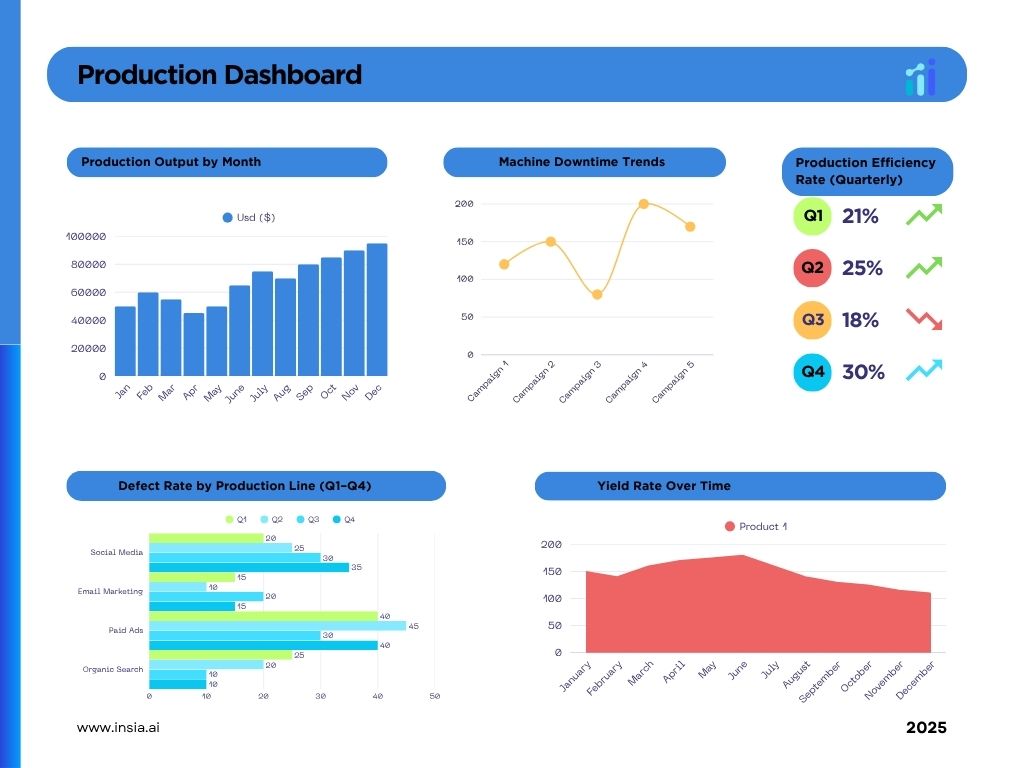
Benefits of Tracking Production KPIs
- Improve operational efficiency and throughput
Production KPIs help manufacturers monitor cycle time, takt time, and overall throughput. This insight allows teams to identify bottlenecks, streamline workflows, and reduce production delays — ultimately improving output with the same or fewer resources.
- Reduce machine downtime and maintenance issues
By tracking metrics like Overall Equipment Effectiveness (OEE) and Mean Time Between Failures (MTBF), production teams can proactively schedule maintenance, minimize unexpected breakdowns, and improve asset reliability — reducing costly downtime.
- Enhance product quality and minimize waste
KPIs such as First Pass Yield (FPY) and Defect Rate give visibility into quality control. Monitoring these metrics helps ensure consistent product standards, reduce rework or scrap, and maintain customer satisfaction through reliable production outcomes.
- Optimize resource utilization and labor productivity
Production dashboards track how effectively human and machine resources are used across shifts. Metrics like labor productivity and machine utilization offer insights to balance workloads, improve scheduling, and reduce idle time, ensuring better ROI on manufacturing assets.
- Enable real-time production monitoring and agile decision-making
With real-time dashboards, production managers can monitor performance metrics live, respond quickly to anomalies, and align operations with demand changes — driving agility and continuous improvement across the plant floor.
-
Average Production Line Speed
Total Distance Covered by Line / Time
-
Average Run Time per Batch
Total Run Time / Number of Batches
-
Capacity Load Analysis
(Actual Load / Capacity) * 100
-
Capacity Utilization Rate
(Actual Output / Maximum Possible Output) * 100
-
Cost of Poor Quality (COPQ)
Cost of Defects / Total Production Cost
-
Cost to Produce by Shift
Production Cost per Shift Analysis
-
Customer Order Fill Rate
(Orders Fulfilled On-Time / Total Orders) * 100
-
Cycle Time Analysis
Total Time to Complete One Cycle / Units Produced
-
Daily Maintenance Completion Rate
Maintenance Tasks Completed / Planned Tasks
-
Defect Density
(Defective Units / Total Units Produced) * 100
-
Delivery Lead Time
Average Time from Order to Delivery
-
Downtime Rate
(Downtime Hours / Total Available Hours) * 100
-
Energy Cost per Unit Produced
Total Energy Cost / Units Produced
-
Energy Utilization Effectiveness
(Effective Energy Used / Total Energy Available) * 100
-
First Pass Yield (FPY)
(Good Units Produced / Total Units Produced) * 100
-
Forecast Accuracy for Demand
(Actual Demand - Forecasted Demand) / Forecasted Demand
-
Hourly Output per Line
Total Output / Total Lines
-
Inventory Accuracy
(Recorded Inventory / Actual Inventory) * 100
-
Inventory Turnover Ratio
Cost of Goods Sold / Average Inventory Value
-
Labor Overtime Rate
(Overtime Hours / Total Hours Worked) * 100
-
Labor Productivity
Output per Labor Hour
-
Machine Availability
(Available Time / Total Scheduled Time) * 100
-
Machine Changeover Time
Average Time Taken for Machine Changeover
-
Machine Downtime per Shift
Downtime per Shift Analysis
-
Maintenance Cost per Hour
Total Maintenance Cost / Hours Worked
-
Material Utilization Efficiency
(Material Used / Material Planned) * 100
-
Material Yield Percentage
(Material Used / Total Material Available) * 100
-
Mean Time Between Failures (MTBF)
Total Operating Time / Number of Failures
-
Mean Time to Repair (MTTR)
Total Repair Time / Number of Repairs
-
On-Time Delivery Rate
(Deliveries Made On-Time / Total Deliveries) * 100
-
Operator Training Completion Rate
(Operators Completing Training / Total Operators) * 100
-
Order Fulfillment Rate
(Orders Fulfilled / Total Orders) * 100
-
Order Variability Impact
Order Variability Coefficient Analysis
-
Overall Equipment Effectiveness (OEE)
Availability x Performance x Quality
-
Parts per Million (PPM) Defect Rate
(Defects / Total Parts Produced) * 1,000,000
-
Percentage of Unplanned Downtime
(Unplanned Downtime / Total Downtime) * 100
-
Production Bottleneck Analysis
Time Delays in Bottleneck Processes
-
Production Cost per Unit
Total Production Cost / Units Produced
-
Production Cost Variance
(Actual Cost - Budgeted Cost) / Budgeted Cost
-
Production Downtime Root Causes
Categorized Downtime by Root Cause Analysis
-
Production Error Rate
(Production Errors / Total Units Produced) * 100
-
Production Profit Margin
(Production Revenue - Production Costs) / Production Revenue
-
Production Rework Time
Time Taken for Rework per Unit
-
Production Schedule Adherence
(Production Completed as Scheduled / Total Production) * 100
-
Production Volume Growth Rate
(Current Period Production - Previous Period Production) / Previous Period Production
-
Quality Inspection Pass Rate
(Units Passing Inspection / Total Inspected Units) * 100
-
Rework Percentage
(Reworked Units / Total Units Produced) * 100
-
Root Cause Analysis Frequency
Frequency of Conducting Root Cause Analysis
-
Safety Incident Rate
(Safety Incidents / Total Hours Worked) * 100
-
Scrap per Shift
Scrap Produced per Shift
-
Scrap Rate
(Scrapped Units / Total Units Produced) * 100
-
Setup Time Efficiency
Setup Time vs Ideal Setup Time
-
Sustainability Metrics (Carbon Emissions)
Total Carbon Emissions from Production
-
Throughput Rate
Units Produced / Time Taken
-
Units Produced per Hour
Units Produced / Total Hours Worked
-
Waste Reduction Percentage
(Initial Waste - Current Waste) / Initial Waste * 100
-
Work-In-Progress (WIP) Trends
WIP Inventory Trends Over Time
-
Worker Efficiency Variability
Worker Output by Efficiency Group
-
Workforce Utilization Rate
(Worker Hours Worked / Total Available Hours) * 100
-
Yield Trend Analysis
Yield Trends Over Time